News
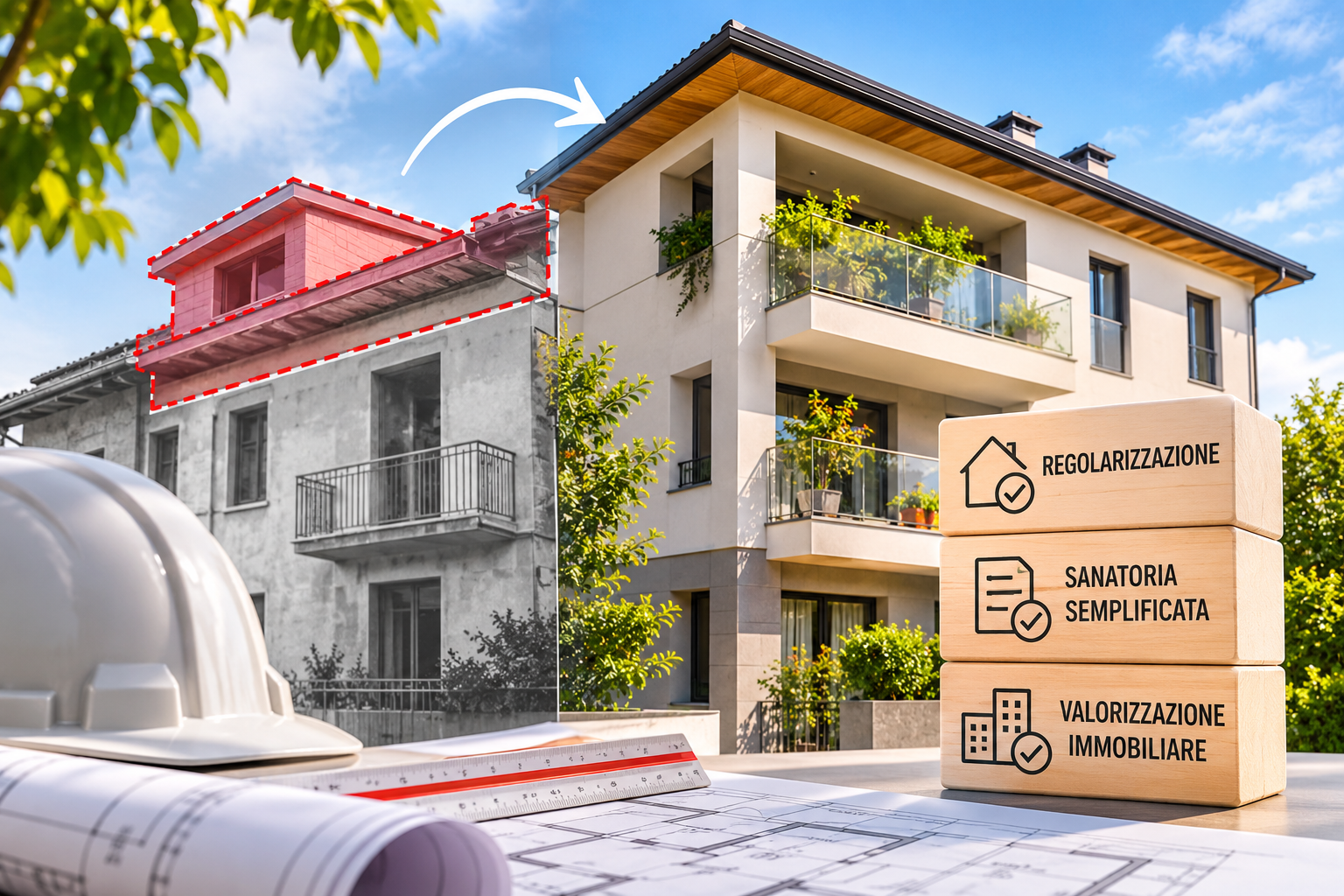
Salva Casa Decree: When Building Irregularities Can Be Legalized Without Demolition
A building may undergo alterations that differ from its originally approved design without necessarily requiring demolition.
With the introduction of the Salva Casa Decree (Decree-Law No. 69/2024, converted into Law No. 105/2024), Italy´s regulatory framework has opened up new opportunities to legalize certain building irregularities, providing more flexible procedures for the rehabilitation of existing properties.
These changes are particularly relevant to essential deviations from approved building plans, meaning alterations that significantly affect the characteristics of a previously authorized construction project.
WHEN DOES A BUILDING ALTERATION BECOME A SIGNIFICANT VIOLATION?
Not all deviations from an approved building project have the same legal significance.
Some alterations may fall within permitted construction tolerances or constitute minor discrepancies, while others substantially affect the building´s dimensions, intended use, or configuration.
Article 32 of Presidential Decree No. 380/2001 establishes the general criteria for identifying essential deviations, while regional legislation provides more detailed classifications.
The most significant cases include:
• Substantial increases in building volume or floor area compared with the approved project;
• Changes in the intended use of a property affecting urban planning standards;
• Significant modifications to building parameters or the location of the structure;
• Alterations to the fundamental characteristics of the originally authorized development;
• Serious violations of seismic construction regulations.
Correctly classifying the alteration is essential to determine the applicable procedure and whether legalization is possible.
WHAT HAS CHANGED WITH THE SALVA CASA DECREE?
Previously, essential deviations were generally subject to the enforcement framework applicable to more serious building violations, potentially resulting in demolition orders.
The legislation introduced in 2024 expanded the circumstances in which certain unauthorized works may be regularized through a building compliance assessment procedure.
The main reference is Article 36-bis of the Italian Consolidated Building Act, which also covers essential deviations in the circumstances established by law.
This does not mean that every unauthorized alteration can automatically be legalized. Instead, the legislation provides a more flexible framework for assessing specific types of irregularities.
BUILDING AND PLANNING COMPLIANCE: TWO DIFFERENT REQUIREMENTS
One of the most important changes concerns the dates against which compliance must be assessed.
For cases falling under Article 36-bis, two separate requirements must be verified:
• Compliance with building regulations in force when the unauthorized work was carried out;
• Compliance with urban planning regulations in force when the legalization application is submitted.
This approach differs from the traditional double-compliance requirement under Article 36, which applies to construction carried out without a building permit or in total deviation from the authorized project.
The distinction may be particularly important for properties altered many years ago, especially where local planning regulations have subsequently changed.
ATTIC CONVERSIONS, BUILDING EXTENSIONS AND CHANGES OF USE
Alterations involving attic spaces and increases in building volume are among the situations requiring particular attention.
Changes to internal ceiling heights, the creation of additional rooms, or the conversion of ancillary areas into habitable accommodation may constitute significant deviations from the original building authorization.
In these circumstances, checking cadastral documentation alone is insufficient.
A comprehensive assessment must consider building volume, floor area, intended use, planning parameters and construction requirements, together with any applicable restrictions and regional regulations.
LEGALIZATION IS NOT AUTOMATIC
The Salva Casa Decree does not establish a general amnesty for unauthorized construction.
The possibility of obtaining retrospective building authorization depends on satisfying the statutory requirements and successfully completing the necessary technical and administrative assessments.
Additional obligations may include structural compliance checks, landscape authorizations, corrective building works and payment of applicable penalties.
Where the legal requirements cannot be met, enforcement measures may still apply, including the removal or demolition of unauthorized works.
WHY IS A PRELIMINARY TECHNICAL ASSESSMENT ESSENTIAL?
Before submitting a legalization application, it is advisable to reconstruct the property´s building and planning history.
A professional assessment should include:
• Examination of municipal planning and building records;
• Survey of the property´s existing condition;
• Comparison between approved drawings and completed works;
• Identification and classification of building discrepancies;
• Verification of applicable planning and construction regulations;
• Assessment of the appropriate legalization procedure and associated costs.
This process helps establish whether there are realistic opportunities to regularize the property before initiating administrative procedures or committing financial resources.
NEW OPPORTUNITIES FOR EXISTING REAL ESTATE
The updated regulatory framework may facilitate the rehabilitation and enhancement of properties affected by historical building irregularities.
The possibility of legalizing certain alterations is particularly relevant to property transactions, renovation projects and real estate redevelopment investments.
For property owners and investors, understanding the applicable procedures can help reduce uncertainty and support more informed decisions.
CONCLUSIONS
The Salva Casa Decree has changed how certain building irregularities are addressed in Italy, introducing procedures that may allow unauthorized alterations to be legalized without demolition, provided specific legal requirements are satisfied.
However, the essential starting point remains a thorough technical and regulatory assessment of the property.
Each situation must be evaluated individually, considering the nature of the alterations, when they were carried out, and the relevant planning and building regulations.
Regularizing a property begins with understanding its actual legal and technical condition and identifying a compliant, sustainable solution that protects its long-term value.
DOES YOUR PROPERTY HAVE BUILDING OR PLANNING IRREGULARITIES?
A preliminary technical assessment can help identify possible legalization procedures and clarify the requirements applicable to your property.
Contact DES&CON for a professional evaluation of building compliance, planning regulations and potential regularization opportunities in Italy.
-
07/11/2026
Mold and Moisture in Buildings: From Causes to Solutions -
29/07/2026
Construction Tolerances: When Building Alterations Become Violations -
02/04/2026
Salva Casa Decree: When Building Irregularities Can Be Legalized Without Demolition -
10/01/2026
Legal Building Status and Cadastral Compliance: Essential Checks Before Buying or Selling Property in Italy -
30/09/2025

Conto Termico 3.0: 2025 Incentives for Energy Efficiency and Renewable Sources -
13/06/2025

Building Distance Regulations: Notarial Council Guidelines on Demolition, Reconstruction, and Out-of-Shape Extensions in Historic Areas -
21/03/2025
Windows with Integrated Ventilation: Comfort, Efficiency, and Key Limitations to Know -
24/01/2025
Interior interventions and building regulations: when a wall doesn´t become an abuse -
04/10/2024
Exploring the Potential of Renewable Energy Communities